
Toxic Self-Sufficiency
We The People Can't Lift Ourselves Up By Our Bootstraps.

My wife and I are coming to the end of a three-week long effort to raise funds for our little ecoversity project here in Thailand that attempts to remind friends from around the world how to live in Right Relation with eARTh. It has been quite an experience. As with all things we do, life offers lessons around each turn. The more we lean into life, the more life responds.
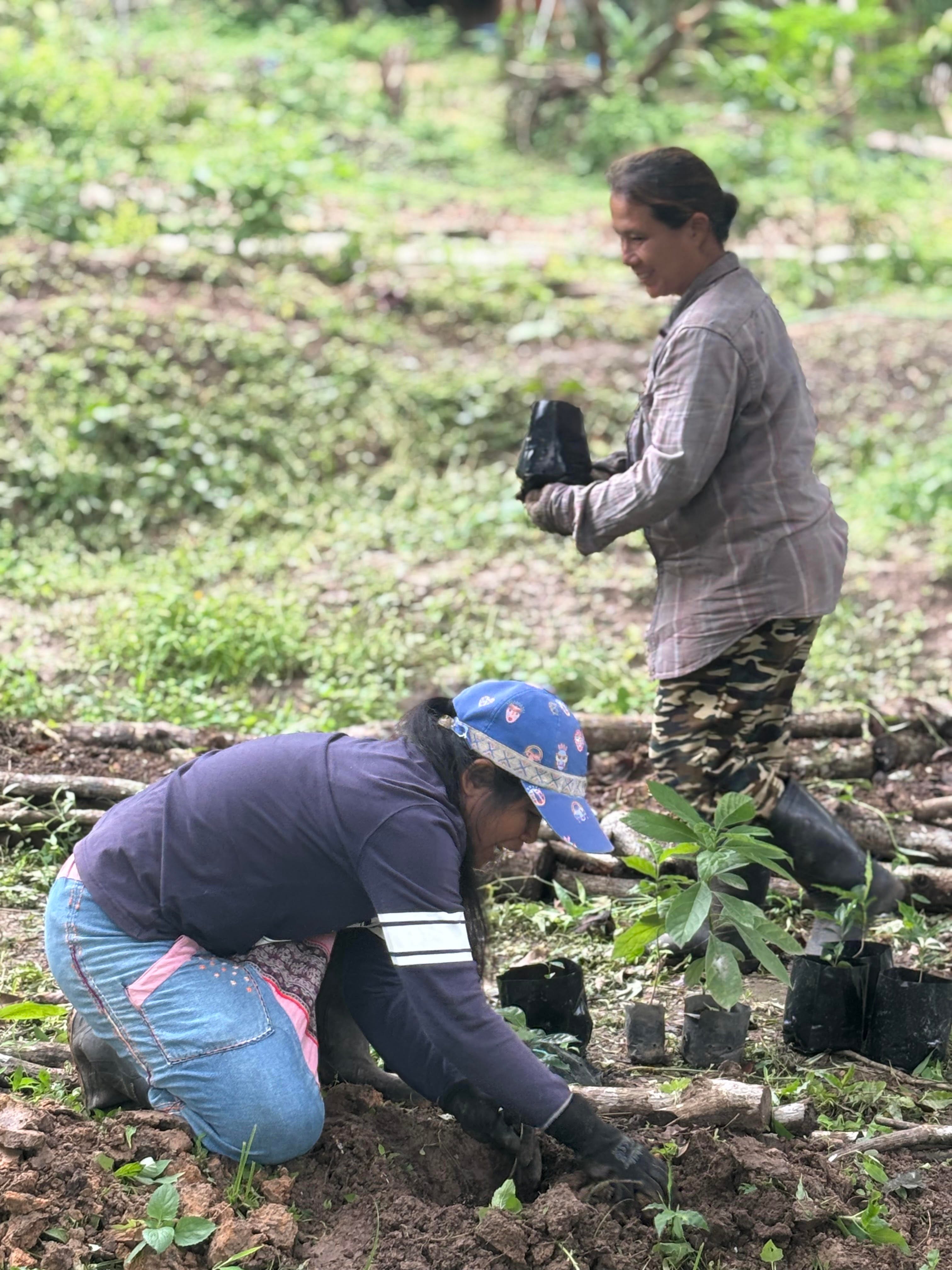
My wife and our friend Am, planting coffee trees at Panya Forest, Thailand.
With the exception being when I use to volunteer at a local radio station back in my Colorado days, when twice a year we would spend several weeks trying to get listeners to support their local airwaves by donating their hard-earned cash to KBUT!, this has been my first real attempt at raising funds, i.e. asking others to give me money. It is hard. In fact, asking for money, at least for me, may be my absolute least favorite thing to do. But ultimately, what is being done is simple and very human. We are being vulnerable, admitting we can’t succeed alone, and as such, asking our community to help us.
I have lived in “self-sufficiency” communities for nearly twenty five years. I have visited countless villages and farms throughout the world that aim to “live off the grid” and cut ties with “the man”. Indeed, we as humans can benefit greatly from learning how to fend for ourselves. It is a noble task we all should pursue. How foolish indeed to not learn to grow food or save seeds for example! However, no matter how good we get at chopping wood and carrying water we will never escape what Chris McCandless (of Into the Wild fame) learned the hard way. We need each other.
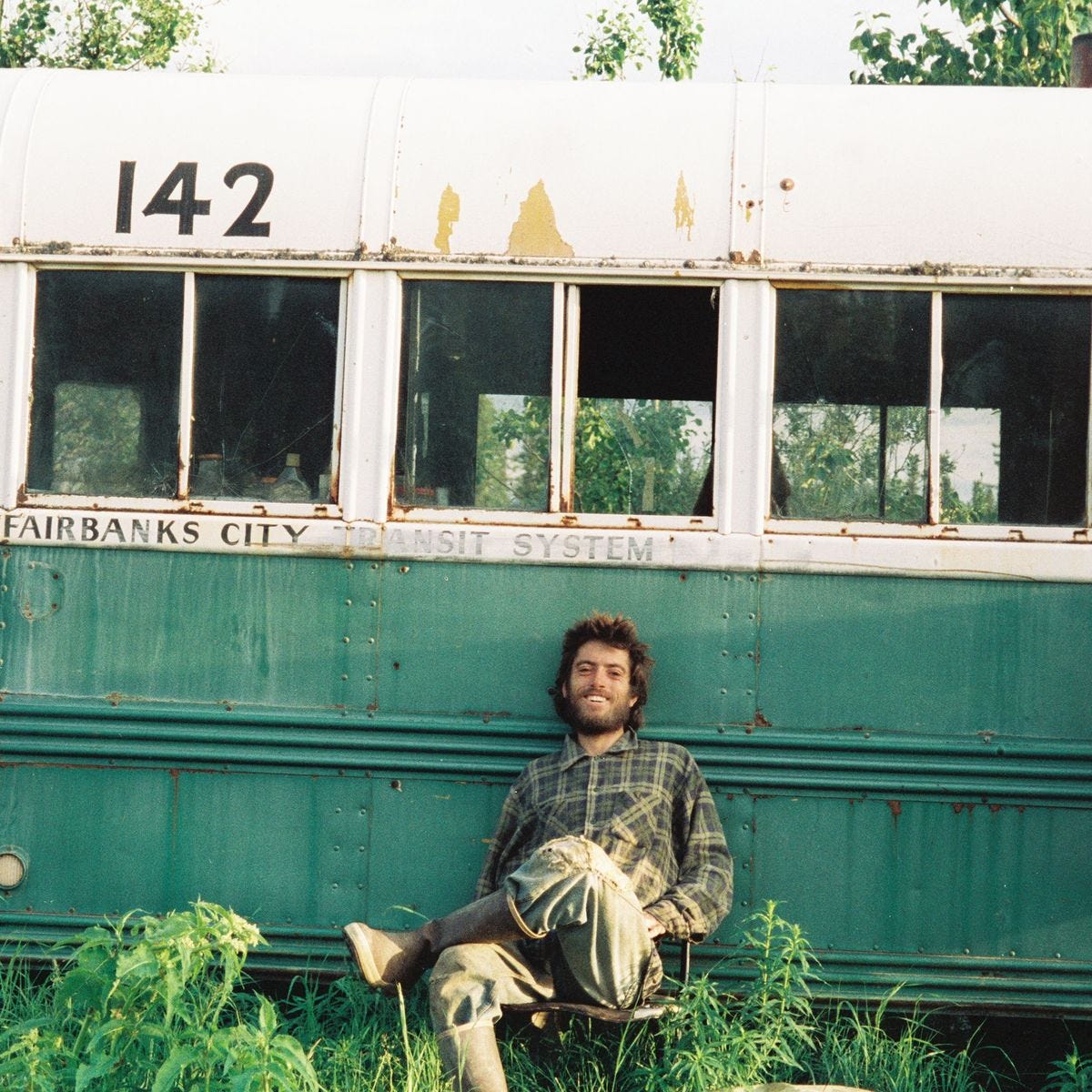
Chris McCandless in front of the bus he found in the wilds of Alaska
…
There is a toxic view of self-sufficiency rising like an unwanted weed in these troubling postmodern days of cultural decay. My wife and I have experienced gross versions of this over the last few weeks with trolls who send us hate-mail stating that we are lazy, terrible people for asking others to help fund our project. But a more subtle, far more troubling misunderstanding of self-sufficiency that is less easy to recognize is increasingly present in the bedrock of our perversely amnesiatic “civilization” that I fear is a root cause as to why so many of the myriad movements attempting to move culture forward fail.
One of the gentlemen who sent us hate mail this week is a farmer from Appalachia. He comes from a long line of hard working back-to-landers. He proudly shared how he and his farm community never ask for help. Though I have never visited his farm, I can say with confidence, this is false. No human can survive without the help of others. It simply cannot be done. And our increasing fear and inability to ask for help may very well lead to our ruin.
I am sad to share that I have had several friends (and yet more friends of friends) commit suicide recently. Almost all of them were community builders, farmers and the like. All of them were recognized by their peers as “self-reliant”. No one saw it coming. No one knew they needed help. And our dearly departed, never asked for any.
Buddhism teaches us that nothing in the manifest world can exist on its own. All phenomena is merely the result of myriad relations with other changing phenomena. A wooden table, for example, cannot be a table without its relation with the saw that cut it, the nail that connects its legs to its shiny surface, the polish that makes it shiny, the floor that supports it ability to stand, etc. And of course if we look more deeply still, we can see that the wood from which the table is birthed is itself only the temporarily manifesting result of clouds that poured rain gently on a seed that made a tree (whom herself only was able to grow because of the help it received from soil and sun). This is the way it is.
It is but the result of a grossly manipulated understanding of self-sufficiency that many in our modern world view the act of asking others for help as poor behavior. Indeed, all one must do is look to the highest ranks in society to learn that they only are able to do what they do because they spend a great deal of time, well, asking for help. Ironically, these same gangsters (cleverly called politicians) who convince us to give them money so they can get rich off wars, carefully construct narratives of which they tirelessly feed into the zeitgeist that suggest that the poor, hardworking people who have the audacity to ask for help, so they can plant trees and feed others are ruining our society. They paint pictures of “immigrants” who take more than they give, even going so far as to blame them for high gas prices and increasing rates of cancer and drug abuse. Slowly, we believe them and we adopt a capitalistic view of self sufficiency that demonizes mutual aid.
To associate asking others for help with the demise of society may vary well be the end game made manifest. For there is nothing more central to being human than to see and be seen by others. To be able to give and to recieve from a community of people you love and trust. To feel safe and supported enough to be openly vulnerable in times of need should be a sign of a healthy, functioning society.
Yet most of us are terrified to ask others for help. My friends who chose to end their lives sure were. I can feel the deep grief in the tone of the hate mail we receive. People of this time are overwhelmed, angry, sad and alone. All results from an inability to find needed support. Many people of this post-modern meltdown have become dangerously fragile, exceedingly afraid of losing what little they have and are very close to forgetting all together what it means to be human.
But not everyone! Just like we as seed savers know, that nearly 98% of all seeds on planet earth have gone extinct in the last 40 or so years because of industrial/modern living practices, some seeds still miraculously live! So too is this true of generous humans who still know what it means to be a villager. All villagers know what healthy peoples have always known. We need each other.
It’s hard to say where the road we are collectively on now is leading. We here at Panya Forest will continue planting trees each day, in the hopes that long from now a people we will not know will benefit greatly from the works we have here done, works we could not and cannot do, without the help from many others. People like you.
Thank you to my longtime readers who have patiently allowed me to commit to this effort over the last couple of weeks. I will return to offering more diverse writings next week.
A deep bow of gratitude to everyone who has made a financial contribution to our fundraising efforts thus far. There still is time to make a contribution if you haven’t already. Thanks to the good people at Ma Earth, Imaginal Seeds, and many others (too many to name) each donation will be multiplied.
The fundraiser ends July 21.
All blessings,
No misfortune.
Please, if you are in need…
Ask for help.
#maypeaceprevailoneARTh
🍉
…
In loving memory of those who left us too soon.
We need to help each other in these times and be willing to be helped. Best of luck to you and your community, Gregory.
Interesting thoughts. I think a lot about alternatives to money, it seems the game is to earn as much as possible by whatever means then use that to build a better life and help others, which doesn’t make sense to me. But money is absolutely necessary.
Perhaps the angry farmer is thinking about who we ask and for what. If you ask for help from a neighbour because they have a tractor and you don’t, but you can make amazing cakes and make a reciprocal arrangement without even thinking about it, that doesn’t feel like ‘charity’, it feels like a mutually supportive community. When relationships are real and organic I expect you don’t even know when you’re asking for help. (I’m being very generous to the angry farmer here, but I think the logic stands).
I have worked in charity fundraising for a few years and asking money is difficult, but asking money from the right people is almost easy. It seems to me, and I’m just thinking about this after reading your blog, that those who get joy from giving to your specific cause are getting something in return. It is in a weird way more reciprocal. All the advice to charities is around building and nurturing relationships, not in a cynical way, but in having a relationship with your donors you both get more out of the arrangement.